The audience is becoming part of the show
NEWS•Masoud Loghmani•August 27, 2026
AI is making entertainment easier to produce and harder to distribute. JaduQuest is one way we’re exploring what comes next: worlds that give fans a reason not just to watch, but to participate.
In my last post, I wrote about what we’ve spent the past year building at Studio Jadu. In that post, I mentioned an idea that plays into one of the most unique aspects of what we’re doing at Jadu:
Democratizing production does not automatically democratize distribution.
In other words, more people crafting stories does not automatically mean those stories will travel far and wide nor reach the right audiences. Why? Let’s take a look:
We are building AIDA to help artists create animation that would once have required significant resources of a major animation studio. But if we stop there, just after artists spend all their effort on putting in a labor of love* to create many new shows…?
What happens then is they face the problem YouTube creators discovered, starting about 20 years ago. You had the production tools of a studio. But how do you find viewers without the marketing muscle of a studio, especially when dramatically more people can make dramatically more content?
This led me to start Studio Jadu with the following filter in mind: “What would Walt Disney do if he was starting a studio today? How would he think of building reach?”
The answer is: fandoms.
Engagement is the secret sauce of fandoms
Traditional entertainment has been unidirectional: creators create, audiences consume.
But think about what people do when they really love characters. They quote them, they discuss theories, maybe even create art using the characters or dress up like them and attend conventions. There are fanfictions, memes, fancasts, fan edits… Fandoms become a type of community centered on a particular IP. More than anything, fans want to create. That’s their way of expressing their love, and reimagining a character through their own lived experiences.
The internet made all of that not only much more visible, but also, arguably, more powerful. A fan’s response to a piece of entertainment can now become entertainment itself, reaching an audience beyond the people who saw the original and funneling attention back toward the source.
Today’s audiences, especially younger audiences, are increasingly expecting to be able to participate in this kind of engagement.
That’s a very different model than sitting down at 8pm in the isolation of your own living room to watch a show on broadcast TV. This has enormous implications for how new entertainment gets built and distributed, and it’s core to how we’ve designed Studio Jadu.
Participation is a form of distribution
Distribution today is more than just getting a film into theaters or a bigger budget to buy media. It’s also gone beyond the idea of “winning” the recommendation algorithm and going viral.
One distribution channel that’s easy to underestimate: people.
Fans who create work inspired by properties they love, or talk about that work online, are doing more than “engaging with content.”
Fans turn locked IP to living IP.
As fans extend stories for characters they love, they create entirely new doorways for new audiences to discover those characters. Their interpretation or analysis might reach audiences the creator doesn’t have access to. A remix or edit could make someone newly curious about the source material. Conversations between fans keep material “live” long past its original air date.
You can see how this dynamic becomes especially important in the world of hyper-abundant content. When there is more entertainment competing for every minute of attention, I don’t think the winners will simply be the people who can produce the most or the fastest. The more interesting question is who can turn viewers to engaged fans who spread the word through their own creations? That is a much higher bar.
And that’s why we created JaduQuest
JaduQuest is our way of turning viewers to engaged fans. It may be heresy to say this, but at the core of JaduQuest is the idea that IP lives only when it is shared. So each JaduQuest shares the DNA of a story, down to its core visual assets and video clips to fans, and gives fans the tools and GeniAI credits they need to create a short story. There is of course more to that (see below), including guardrails for brand safety and canon/lore compliance. But that’s the big picture.
The first wave of JaduQuest creative challenges are now live with invitations going out, in waves, to tens of thousands of fans who are on our waitlist. We call them “fanimators.”
Here’s how it all works: Each Quest starts with creative constraints and assets (characters, world, aesthetic, or set of frames), and asks creators to make something of their own from it according to a particular challenge requirement, and using JaduQuest interface (think of it as a highly simplified version of of our AIDA Workbench). We want to explicitly lean into the idea that fans are a valuable part of distribution, and make it easy and fun for them to participate.
Our first Quest was based on the Kuleshov Effect, a film editing effect from the early 1900s. The idea is that the meaning of a frame can change drastically depending on the frames following before or after it. You can show the same beginning and same ending, but what happens in the middle will dramatically change your interpretation and experience of the story.
For this Quest, we gave creators the same starting and ending points and asked them to direct what happened between them. The results showed exactly why fan participation is exciting to me. These are early days, and fans are just starting. But we can already see the eagerness to create.
One creator sees heartbreak where another sees horror. One finds humor where another finds tenderness. The technology helps them execute the idea, but the idea, the decisions about what to show, what to hide, how long to linger, when to surprise us, and what the whole thing ultimately means, all that comes from the artist.
These micro-projects illustrate our belief that AI can generate, but only artists originate. That principle runs through both Studio Jadu’s AIDA Workbench and JaduQuest: technology should give creators greater ability to express creative intent, not make those decisions for them.
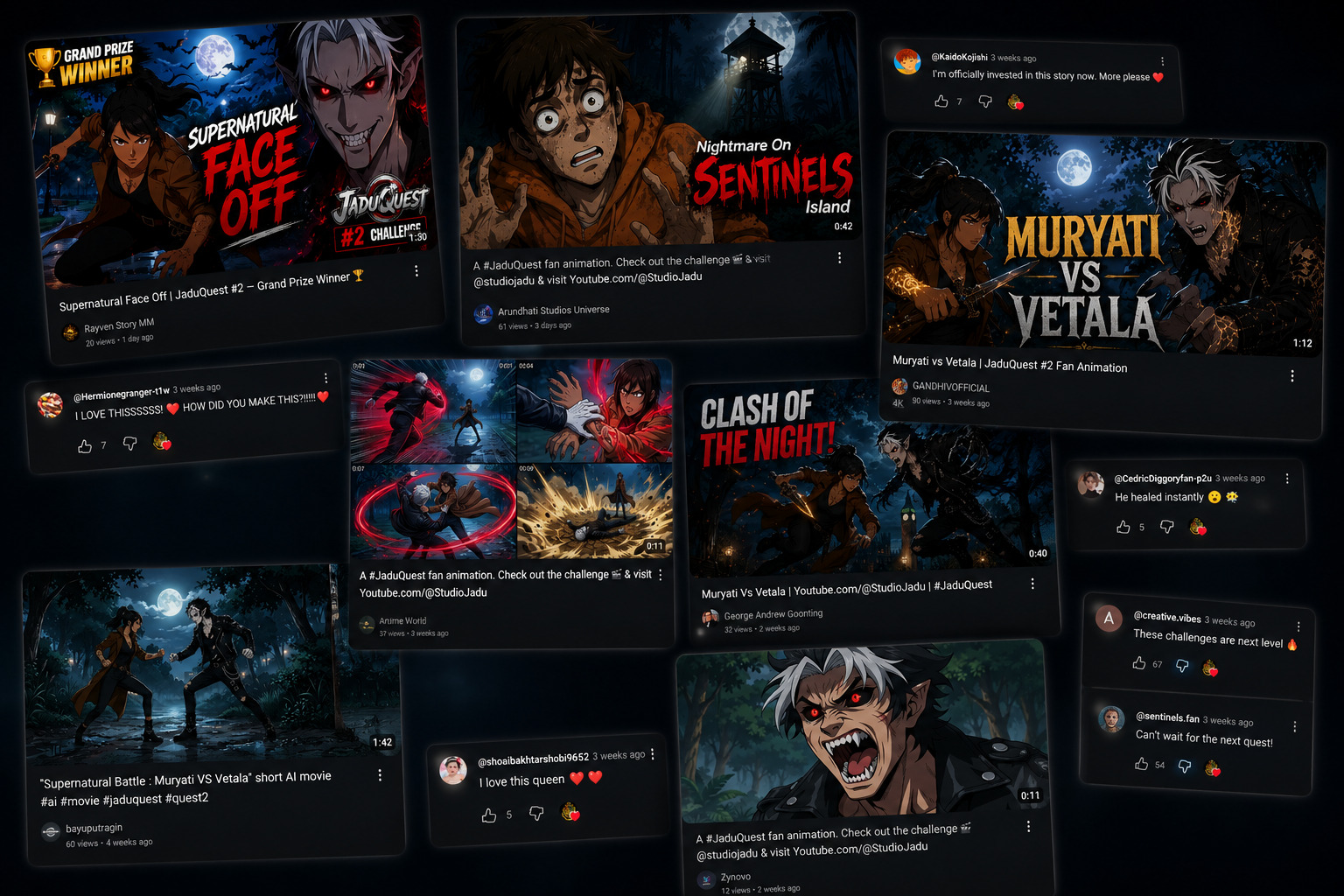
For all the latest JaduQuest content, see what our fanimators are making on YouTube.
Up next with JaduQuest…
Interested in becoming a fanimator? Join the next quest here.
*Yes! Real art STILL takes art and effort. Prompt slot machines don't replace taste and art.
Follow Jadu
for more!


